
As a company originating from Japan, we are committed to delivering authentic Asian flavors to consumers across Europe. Guided by our corporate vision, “EARTH FOOD CREATOR,” we strive to develop products that are sustainable for our planet and contribute to building a more sustainable society.
We focus on five key themes identified as our core sustainability materialities. For environmental topics, our initiatives are aligned with the NISSIN FOODS Group’s environmental strategy and targets.
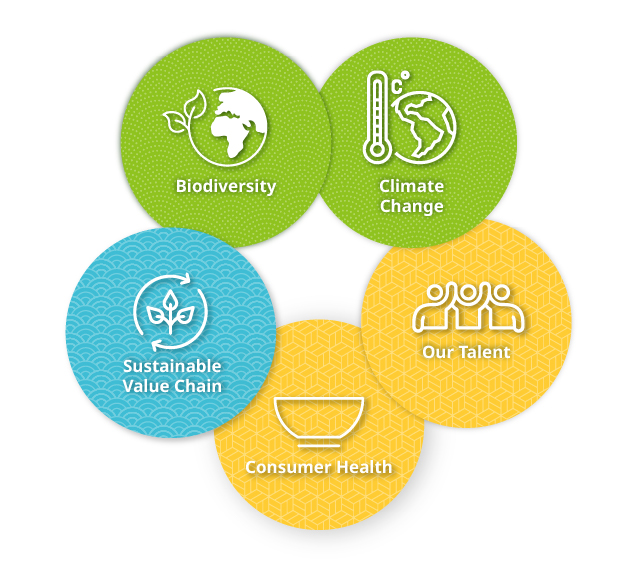

We, at NISSIN FOODS Europe, started by assessing and evaluating our materiality.
We now have a management system in place to monitor our progress and review it in accordance with acknowledged standards.
Step 1
We identify key stakeholders across our value chain and directly engage with them to assess sustainability matters that are material to our business. The outcomes of this assessment are reflected in the subsequent IRO (Impacts, Risks and Opportunities) assessment.
Specifically, we conduct surveys targeting consumers and our employees, as well as interviews and surveys with customers.
Step 2
Building on the insights obtained in Step 1, we identify and assess our material impacts on the environment and society, as well as sustainability-related risks and opportunities that may affect our financial position, financial performance and future cash flows.
This includes a quantitative assessment of financial effects arising from our exposure to sustainability-related risks and opportunities, in line with the ESRS requirements.
Step 3
The Management Board evaluates and approves our material sustainability matters based on the results of Step 1 and Step 2, taking into account our company mission, vision, values and mid- to long-term strategy.
This process ensures the consistent application of the double materiality principle, combining both impact materiality and financial materiality perspectives.
Natural capital—including the climate that enables the production of our raw materials—is a fundamental asset for our business.The NISSIN FOODS Group has set targets to reduce greenhouse gas (GHG) emissions by 42%* for Scope 1 and 2 (direct emissions) and by 25%* for Scope 3 (indirect emissions) by 2030. The NISSIN FOODS Group participates in the Science Based Targets initiative (SBTi). For NISSIN FOODS Europe, we have set climate protection targets that are aligned with our growing production capacities. Therefore, we aim to reduce our carbon intensity by 42%* for Scope 1 and 2 (direct emissions) and by 25%* for Scope 3 (indirect emissions) by 2030. We aim to achieve these targets through the use of renewable energy and emission reductions driven by collaboration with key stakeholders across our value chain.
(* Compared to the baseline year 2020)
Read less
Read more
To enhance long-term economic sustainability, we have been strengthening the resilience of our supply chain.
Specifically, we aim to diversify all critical raw material suppliers by FY2028, while conducting sustainability due diligence for all suppliers—primarily upstream—by FY2030.
This due diligence includes direct engagement and dialogue with our suppliers.
Read more
Read less
At the core of our products are our consumers who choose them, the natural capital services that enable their creation, and our employees who bring them to life.
We strive to offer products that support both consumer health and planetary health. By FY2030, we aim to increase the share of our wellness products* to 25% of total sales.
In addition, we provide all employees with appropriate health support, wellness benefits, and role-specific training on an annual basis.
(*Wellness product – NISSIN FOODS Europe defines wellness products as contributing to planetary health and human well-being, i.e. vegetarian and vegan products or products containing additional essential nutrients.)
Read more
Read less
NISSIN FOODS Europe has set targets to reduce the carbon intensity by 2030.
Scope 1+2 by 42%*
Scope 3 by 25%*
| 2020 | 2021 | 2022 | 2023 | 2024 | |
|---|---|---|---|---|---|
| Scope 1+2 | - | +9.0% | +15.3% | +17.0% | +20.3% |
| Scope 3 | - | -0.5% | +21.5% | +74.4% | +67.8% |
| Carbon Intensity Scope 1+2** | - | -3.2% | -14.1% | -26.9% | -30.1% |
| Carbon Intensity Scope 3** | - | -11.7% | -9.4% | +8.9% | -2.5% |
We have our own factory in Hungary. To meet our strong demand, we have installed a new production line for bag-type products in FY03/2024, and another new line for cup-type products in FY03/2025. This is reflected in higher overall GHG emissions*** as well as a higher carbon intensity for 2023 and 2024.
* Baseline year 2020
** Carbon intensity is calculated in GHG emissions per sold product.
*** The GHG emissions were calculated by NISSIN FOODS Holdings CO., LTD. Find the third-party verification here.
| 2022 | 2023 | 2024 | 2025 |
|---|---|---|---|
| 100% | 81.7% | 100% | 100% |
| 2022 | 2023 | 2024 | 2025 |
|---|---|---|---|
| 65.8% | 66.3% | 63.2% | 52.8% |
This number shows the share of key raw materials purchased from a single main supplier across categories based on spend.
| 2024 | 2025 | |
|---|---|---|
| Share of expenses | 69.2% | 72.2% |
Society: Targets and Progress
Target: Increase the share of total sales of wellness products to 25% by 2030.
Share of Wellness Products in Total Sales
2025: (preliminary)
17.2%
